 spendzbot
expense tracking habit India
The Expense Tracking Habit in India: UPI Made Spending Easy — Tracking Didn't Follow
Yaar, we fixed payments.
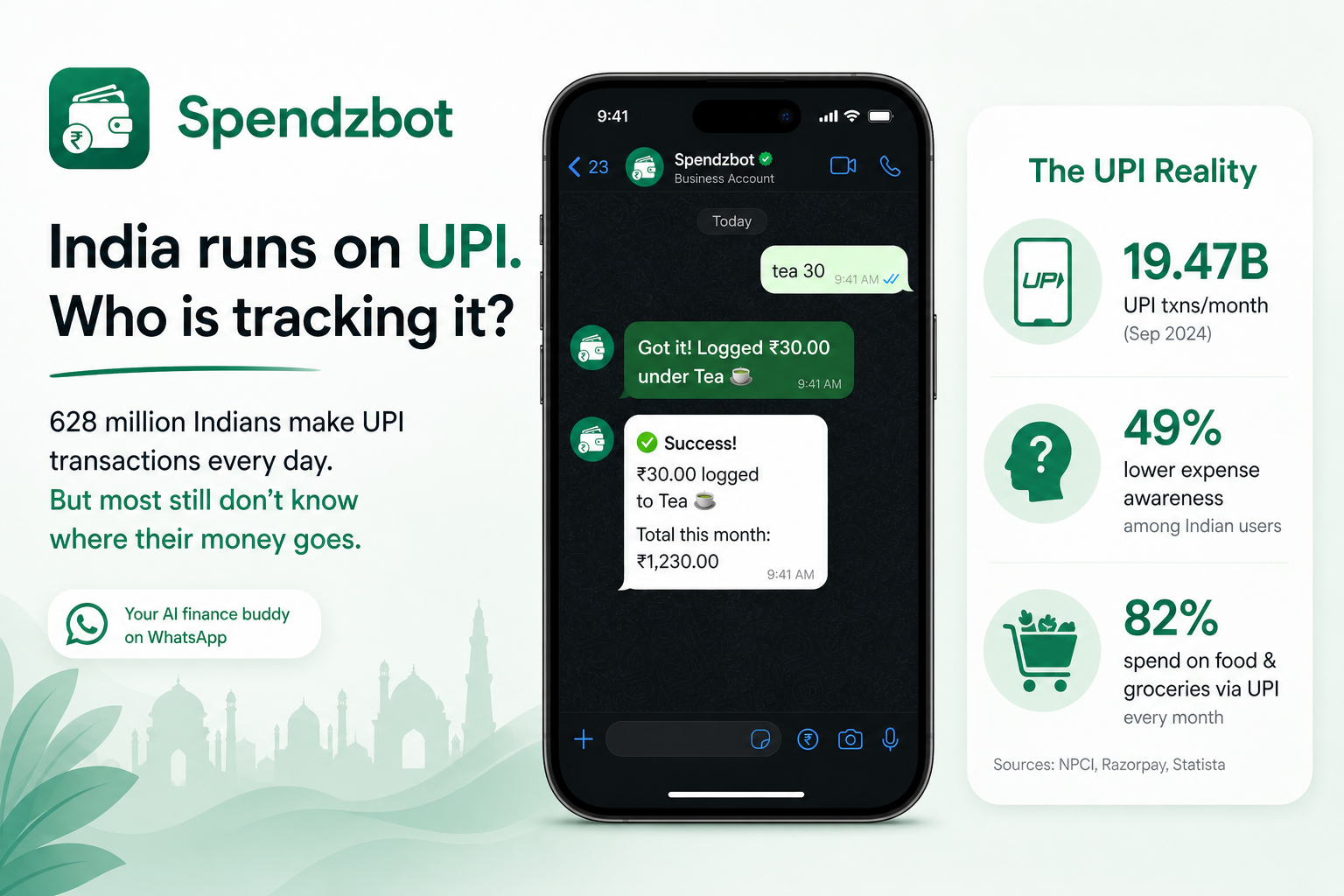
Scan. Tap. Done. Chai for ₹30, Swiggy for ₹350, petrol for ₹800 — all in seconds. India runs on UPI now. 628 million UPI transactions every single day (NPCI, July 2025). That is not a flex. That is a firehose of money leaving your account while your brain catches up later.
Here is the part nobody talks about at dinner parties: we got world-class at spending digitally. We did not get world-class at tracking it.
I am not writing this as a finance expert. I am writing this as someone who checked his balance on the 22nd, felt physically sick, and still could not explain where ₹40,000 went. If that is you too, the data below will make you feel less alone — and maybe angry enough to finally build an expense tracking habit.
New here? Read our WhatsApp expense tracker guide or start free on Spendzbot.
“UPI is so smooth that I spend more — and track less. Salary comes, UPI goes, month ends, panic starts.”
India by the numbers: we pay faster than we remember
Let us look at what the country is actually doing with UPI — because your personal “where did it go?” moment is happening at national scale.
UPI volume (NPCI, July 2025)
| Metric | Figure | Source |
|---|---|---|
| Monthly UPI transactions | 19.47 billion | NPCI |
| Monthly UPI value | ₹25.08 lakh crore | NPCI |
| Daily UPI transactions | ~628 million | NPCI / BusinessLine |
| YoY volume growth | +35% | NPCI |
| Share of digital payments (by volume) | ~85% | Industry reports |
That is not “some people went digital.” That is the default way India pays for groceries, food, fuel, bills, and everything in between.
Where the money actually goes (merchant categories, July 2025)
NPCI’s first merchant-category breakdown tells a very Indian story:
| Category | Transactions (approx.) | Value (approx.) | What it means |
|---|---|---|---|
| Groceries & supermarkets | 3+ billion | ₹64,882 crore | Daily essentials — high frequency, easy to forget |
| Fast food restaurants | 1.22 billion | — | Swiggy/Zomato culture is not “occasional” anymore |
| Eating places & restaurants | 1.15 billion | — | Dining out is a habit, not an event |
| Debt / loan repayments | 161 million | ₹93,857 crore | Big value, low frequency — the serious money |
| Fuel (service stations) | 612 million | ₹35,189 crore | Every commute adds up |
Average ticket size for groceries? Around ₹214 per swipe. Small enough to feel harmless. Repeated enough to wreck a budget without you noticing.
India did not become cashless. India became tap-first. And tap-first lives do not automatically create an expense tracking habit in India — unless you design for it.
The tracking gap: what surveys say about Indian spenders
Payments data is one side. Behaviour data is the punch in the gut.
UPI increased spending — and reduced awareness
Multiple academic surveys on Indian UPI users paint the same picture:
| Finding | Approx. share | Source |
|---|---|---|
| Spending increased after UPI adoption | 55–74% of respondents | IJSSER 2025; ACM/arXiv UPI studies |
| Expense tracking awareness fell after UPI | ~49% | IJSSER 2025 (169 respondents) |
| More impulsive purchases on UPI vs cash | ~52% | IJSSER 2025 |
| Use UPI daily | ~81% | ACM UPI behaviour study |
| Satisfied with UPI convenience | ~91–95% | ACM / arXiv studies |
Read that again. We love UPI. We use it constantly. A huge chunk of us spend more and track less than before.
That is not a moral failure. That is what happens when you remove the “pain of paying” — the mental moment where cash leaving your wallet forced you to remember.
The expense tracker app paradox
India has no shortage of finance apps. The habit still breaks. Research on middle-class digital finance behaviour in India found:
- Digital expense app usage rose from ~29% (2020) to ~53% (2024) — but adoption ≠ habit
- ~47% had installed a budgeting app at some point
- ~74% disabled key features (alerts, dashboards) within 3 months — often due to complexity, notification fatigue, or “no time”
Sound familiar? Download on salary day. Use for four days. Forget. Repeat next month.
The problem is not that Indians do not care about money. The problem is that traditional expense trackers fight how Indians already live — on WhatsApp, in a hurry, with 200 notifications already screaming for attention.
Why the expense tracking habit fails in India (it is not willpower)
Let me tell you what actually kills the habit here — not the lecture version.
1. UPI made spends invisible
When you paid cash, the shopkeeper counted notes and your wallet got lighter. You felt it.
When you UPI ₹40 for chai twice a day, nothing feels different. Your phone buzzes. You move on. By month-end you have made hundreds of micro-payments that never registered as “spending.”
2. Salary day optimism is a national sport
Salary hits. UPI limit feels unlimited for 72 hours. Then EMIs, rent, Swiggy, petrol, “bas ek baar” purchases stack up.
Without tracking, you are not managing money — you are surviving until the next credit notification.
3. Apps ask for effort at the worst moment
Traditional personal expense tracker India apps want you to:
- Open a separate app
- Log in
- Pick categories from dropdowns
- Sync bank accounts
- Feel guilty via a red chart
Meanwhile you are holding bags, waiting for a lift, or replying to your manager on WhatsApp. The habit dies before it starts.
4. Couples share money but not memory
Two people. One household account. Fifty UPI apps. Zero shared log.
End of month: “Kitna kharcha hua?” Two different answers. Same stress every time.
An expense tracking habit for Indian households needs to be shared, simple, and instant — not a spreadsheet war.
The unique fix: build the habit where India already talks
Here is the angle most expense tracker companies miss.
India does not need another app icon on page 4 of the home screen. India needs tracking inside the habit loop that already exists:
Spend → WhatsApp → done.
That is why Spendzbot by Asmora Labs is built as a no app expense tracker on WhatsApp:
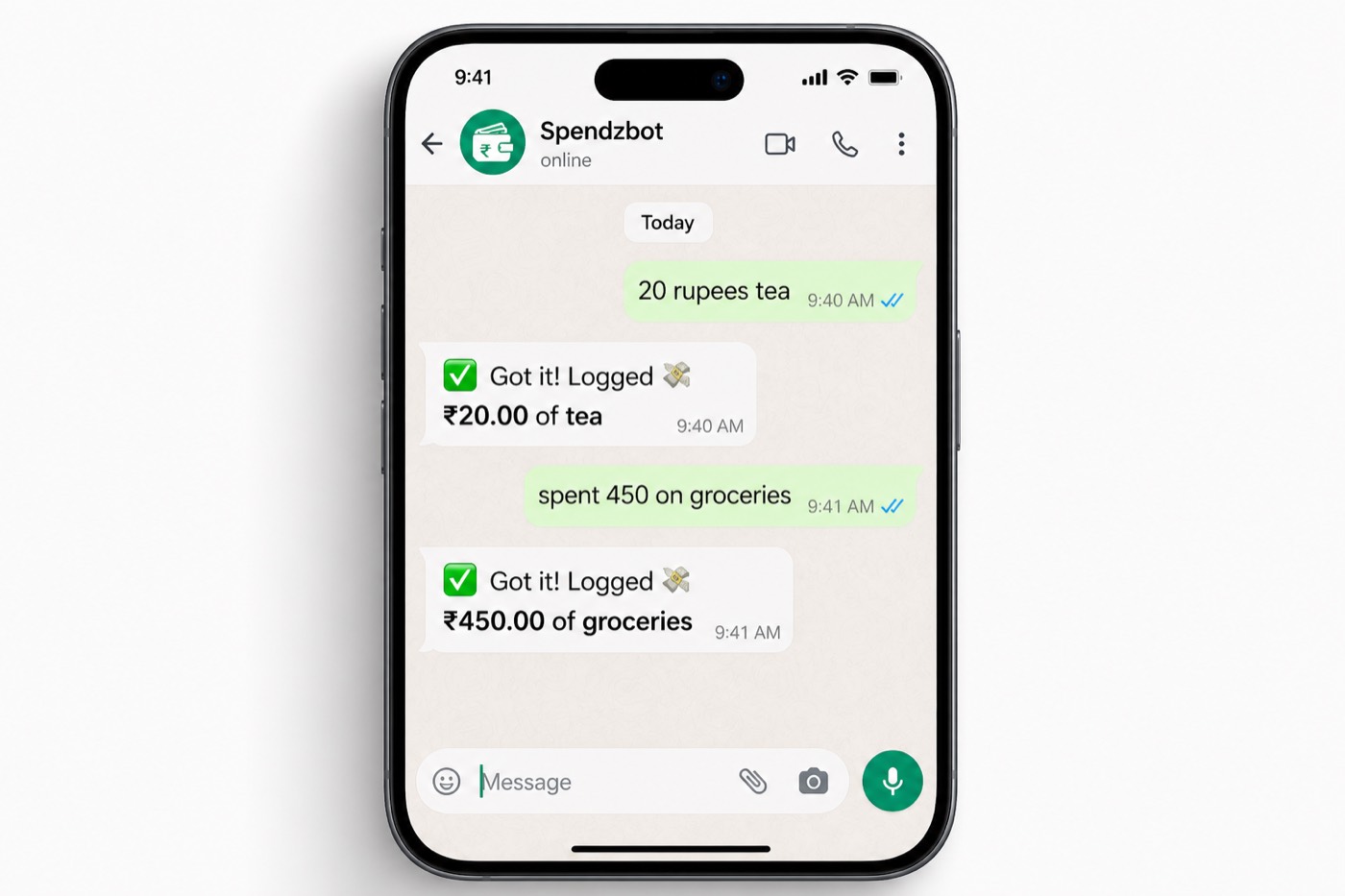
- Log in plain text:
tea 30,petrol 800,swiggy 350 - Get instant confirmation — the small dopamine hit that helps habits stick
- Ask for reports:
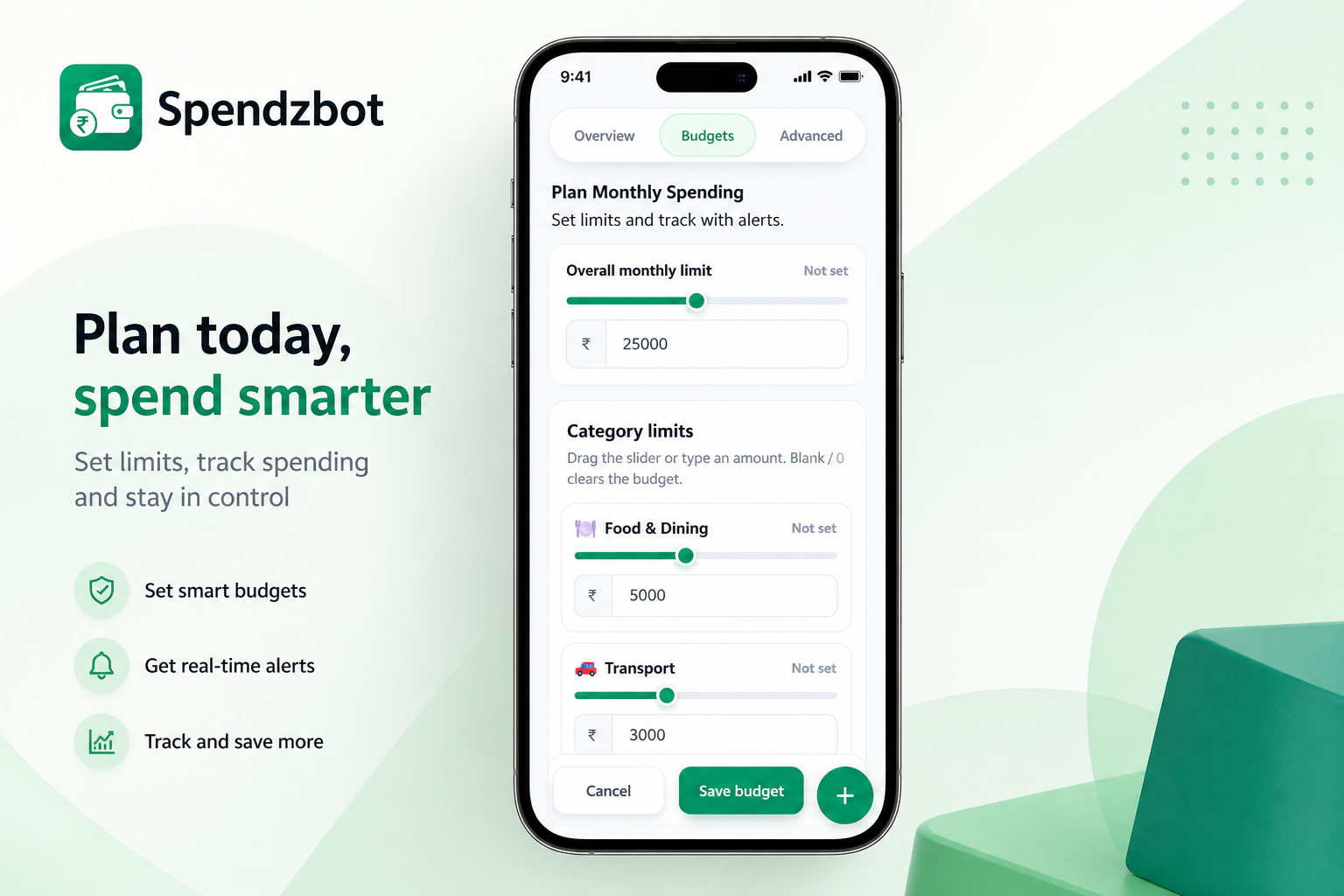
this month report,category report,budget - Set monthly limits on the web; get budget alerts at 75%, 90%, 100% on WhatsApp
- Share a ledger with your partner — couple expense tracker for Indian households
You are not learning a new app. You are texting like you already do 100 times a day.
What a real tracking habit looks like (not perfect, just consistent)
Forget tracking every rupee from day one. Build the habit in layers:
- Week 1 — Log only “big” spends (food delivery, fuel, groceries)
- Week 2 — Add
this month reportevery Sunday - Week 3 — Set one category budget (Food & Dining is usually the leak)
- Week 4 — Check
budget statusbefore a planned purchase
That is it. No CA degree. No colour-coded spreadsheet. Just visibility on a schedule you can actually keep.
What changes when the habit sticks (realistically)
I will not promise you will save ₹50,000 next month. That is influencer nonsense.
What actually happens when you keep an expense tracking habit in India:
- Swiggy stops being “occasional” — you see the number, you decide consciously
- Mid-month panic drops — you know the score on the 15th, not the 28th
- Arguments reduce — shared ledger beats two memories
- UPI stops feeling like Monopoly money — each text after a payment brings awareness back
The data already proved UPI increases spend and reduces awareness. The habit puts awareness back — without giving up the convenience.
Start small: one text after one payment
India solved payments at scale. 628 million transactions a day proves it.
The next problem is not “how do we pay?” It is “does anyone know where it went?”
You do not need to fix your entire financial life this week. You need one habit:
After a UPI payment, send one line to Spendzbot.
That is how an expense tracking habit in India gets built in 2026 — not with another forgotten app, but with the phone habit you already have.
Text Hi to Spendzbot on WhatsApp and log your first expense today. Ask for this month report in seven days. Compare it to how you thought you spent. That gap is the whole lesson.
Also read: Why budget tracking matters · Ending the everyday expense leak
FAQ: expense tracking habit in India
Why is expense tracking harder in India after UPI?
UPI removed the “pain of paying” that cash created. Surveys show many Indian users spend more and track less after adoption — small frequent payments feel invisible until month-end.
What do NPCI statistics show about Indian spending habits?
In July 2025, India recorded ~19.47 billion UPI transactions worth ₹25.08 lakh crore. Groceries, restaurants, and fast food dominate volume — daily micro-spends that are easy to forget without tracking.
What is the best daily expense tracker for India?
For UPI-heavy routines, a WhatsApp expense tracker like Spendzbot works well — log spends by texting (tea 30, petrol 500) with no separate app to maintain.
Why do Indians quit expense tracker apps?
Research cites app complexity, notification fatigue, and friction at the moment of spend. Habits stick when logging is faster than forgetting — e.g. messaging on WhatsApp.
Can couples build a shared expense tracking habit?
Yes. Spendzbot links two Indian WhatsApp numbers to one shared ledger with individual attribution — ideal for household tracking without duplicate entries.
Is Spendzbot free for expense tracking in India?
Yes. WhatsApp logging, reports, budget limits, and alerts are free while the product grows. Built by Asmora Labs for Indian +91 numbers.
More from the blog
Why Budget Tracking Matters (And Why I Wish I Started Earlier)
Salary gone by the 20th again? Here is why budget tracking matters for Indian households — and how Spendzbot helps you set limits, get alerts, and stop flying blind on UPI spends.
The Ultimate Guide to Ending the Everyday Expense Leak with Spendzbot
Stop the salary-to-empty-account cycle. Learn how Spendzbot uses WhatsApp and AI to track UPI spends, send budget alerts, and help couples manage money with zero friction.
WhatsApp Expense Tracker: Stop Silent Money Leaks with Spendzbot
Track daily expenses on WhatsApp with Spendzbot — an AI expense tracker. Log spends in one text, get monthly reports, and share a couple expense tracker. No app download.