 spendzbot
budget tracking
Why Budget Tracking Matters (And Why I Wish I Started Earlier)
It is the 18th. Salary came in what feels like yesterday. I have not bought anything “big” — no new phone, no trip, no fancy furniture. And yet when I open my banking app, the number staring back at me is… embarrassing.
Where did it go?
Swiggy? Petrol? That random UPI for chai? The Amazon order I forgot about? Probably all of it. And the worst part is — I cannot even argue that I was reckless. I was just… not paying attention.
That is when I finally understood something nobody tells you clearly: the problem is not always earning less. The problem is not knowing where it went. That is exactly why budget tracking matters — not to make you feel guilty, but to stop the month-end panic before it starts.
“I earn okay money. I am not reckless. But every month I feel broke before the month ends — and I genuinely cannot explain where half the salary went.”
If that sounds like you, this post is not a product tour. It is the honest story of why tracking a budget changed how I feel about money — and why I think most salaried Indians are one small habit away from the same relief.
New to Spendzbot? See our WhatsApp expense tracker guide or start free on the homepage.
You cannot fix what you refuse to look at
We love the idea of saving. We hate the moment of truth.
Every month starts the same way. Salary hits. You feel rich for six hours. You tell yourself “this month will be different.” Then life happens — UPI taps, delivery apps, auto rides, “bas ek baar” treats — and suddenly it is the 20th and you are checking your balance like it owes you an explanation.
Budget tracking is not about becoming a finance bro. It is about looking at reality early enough to do something about it.
Think of it like this:
- Without tracking — you guess. You hope. You survive till next salary.
- With tracking — you know. You adjust. You still enjoy life — but on purpose, not by accident.
That shift sounds small. It is not. It is the difference between constant low-level anxiety and actually feeling in control.
Why budget tracking matters more in a UPI-first life
Our parents felt money leave the wallet. We tap a QR code and move on.
₹30 chai. ₹50 parking. ₹199 “trial” subscription. ₹400 Blinkit because we forgot onions. None of it feels like “spending.” It feels like background noise. But background noise adds up to thousands — sometimes more than rent-sized chunks — by month-end.
That is the modern Indian money trap:
- Spending is frictionless — UPI is faster than guilt.
- Balances feel abstract — numbers in an app do not hit the same as cash leaving your hand.
- Small spends feel harmless — “ chhoti si baat hai ” is the most expensive sentence in personal finance.
Why budget tracking matters here: it forces those invisible taps to become visible. Not tomorrow. Not at the bank statement. Now — while you still have time to course-correct.
You are not tracking because you hate chai. You are tracking because ten chais a day should be a choice, not a surprise.
The real cost of not tracking (it is not just money)
Before I took budget tracking seriously, I thought the damage was only financial. It was not.
1. The constant background stress
Every UPI payment came with a tiny question: “Should I be doing this?” But because I had no numbers, I could never answer. So the stress just… stayed. Low volume, all day, every day.
When you track — even loosely — that noise drops. You are not wondering. You know where you stand.
2. The month-end argument (with yourself or your partner)
“Kitna kharcha ho gaya?”
“Pata nahi yaar, normal hi tha.”
“Normal mein poora salary gayab kaise ho gaya?”
Sound familiar?
In Indian households — especially when two people spend from one pool — not tracking becomes not trusting. Not because anyone is stealing. Because nobody has the same version of the truth.
Budget tracking is not romance advice. But clarity prevents a lot of unnecessary fights.
3. Goals that never happen
SIP? Emergency fund? Trip home? That course you wanted?
Without tracking, “I will save what is left” means nothing gets left. The money disappears into a hundred small yeses before you notice.
Tracking does not magically make you rich. It protects what you already decided matters.
4. The shame spiral
This one is underrated. You check the balance. You feel stupid. You avoid looking again. You spend more because “already messed up this month.”
Budget tracking breaks that loop. Bad week? You see it on day 8, not day 28. You still have time to recover — without the drama.
Budget tracking is not punishment — that is the biggest myth
I avoided tracking for years because I thought it meant saying no to everything fun.
Wrong.
Budget tracking means deciding once what “enough” looks like — then living freely inside that boundary. It is not “never order Swiggy.” It is “I am okay spending ₹3,000 on food delivery this month — after that, I cook or I wait.”
That is a completely different mental frame:
| Without a budget | With budget tracking |
|---|---|
| Every spend feels random | Every spend fits a plan you chose |
| Guilt after the fact | Awareness before the damage |
| “Can I afford this?” = guess | “Does this fit my month?” = answer |
| Month-end shock | Mid-month correction |
You are not giving up joy. You are giving up confusion.
Why willpower alone will always lose
Let me save you some pain: discipline without a system fails.
You do not forget to scroll Instagram. You do not forget to reply on WhatsApp. But you will forget that ₹80 UPI from Tuesday — because life is busy and money today is designed to be forgettable.
That is why budget tracking matters as a system, not a mood:
- Willpower — “I will be careful this month” (lasts 4 days)
- Tracking — “I log spends and check where I stand” (lasts because it is easy)
- Budget limits + alerts — “Tell me before I cross the line” (lasts because it works while you are busy)
The goal is not to become perfect. The goal is to stop relying on memory in a world built to make you spend without thinking.
What changed when I actually started tracking
I will not pretend I became a minimalist monk. I did not.
But a few things genuinely shifted:
I stopped guessing about food. I thought Swiggy was occasional. Tracking showed ₹6,000+ some months. One number. One reality check. I still order — just not on autopilot.
I caught weekend damage early. Saturday-Sunday spends used to destroy the next week. Now a quick mid-month look tells me if the “small treat” became a “whole personality.”
Salary day stopped feeling like a reset button. I log income when it hits. I watch expenses through the month. The balance is not a mystery box anymore.
Arguments at home reduced. When two people share money, a shared ledger beats two different memories. Data is boring. Boring is peaceful.
None of this required becoming obsessed with spreadsheets. It required one habit: pay attention on purpose.
Setting a budget limit is you talking to future-you
Here is the part that clicked late for me: a monthly budget is not a restriction imposed on you. It is a message you send to your future self.
“Dear future me — we agreed ₹5,000 for food this month. Enjoy it. Just do not accidentally hit ₹9,000 and wonder what happened.”
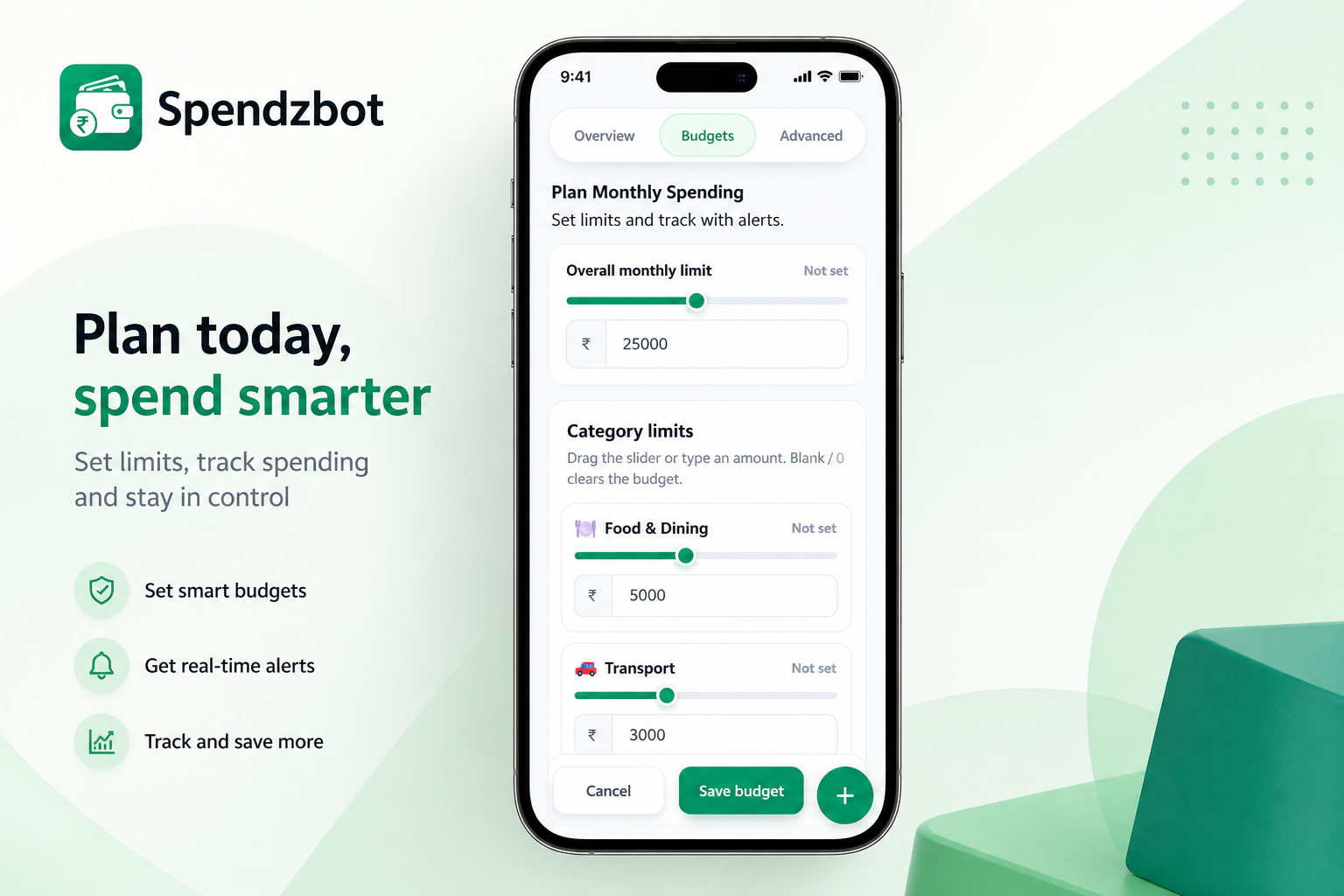
That is what Plan Monthly Spending in Spendzbot is really about — not fancy finance, just a clear boundary you set once:
You set an overall monthly limit and optional category limits — Food & Dining, Transport, and the rest. Drag a slider or type a number. Save. Done.
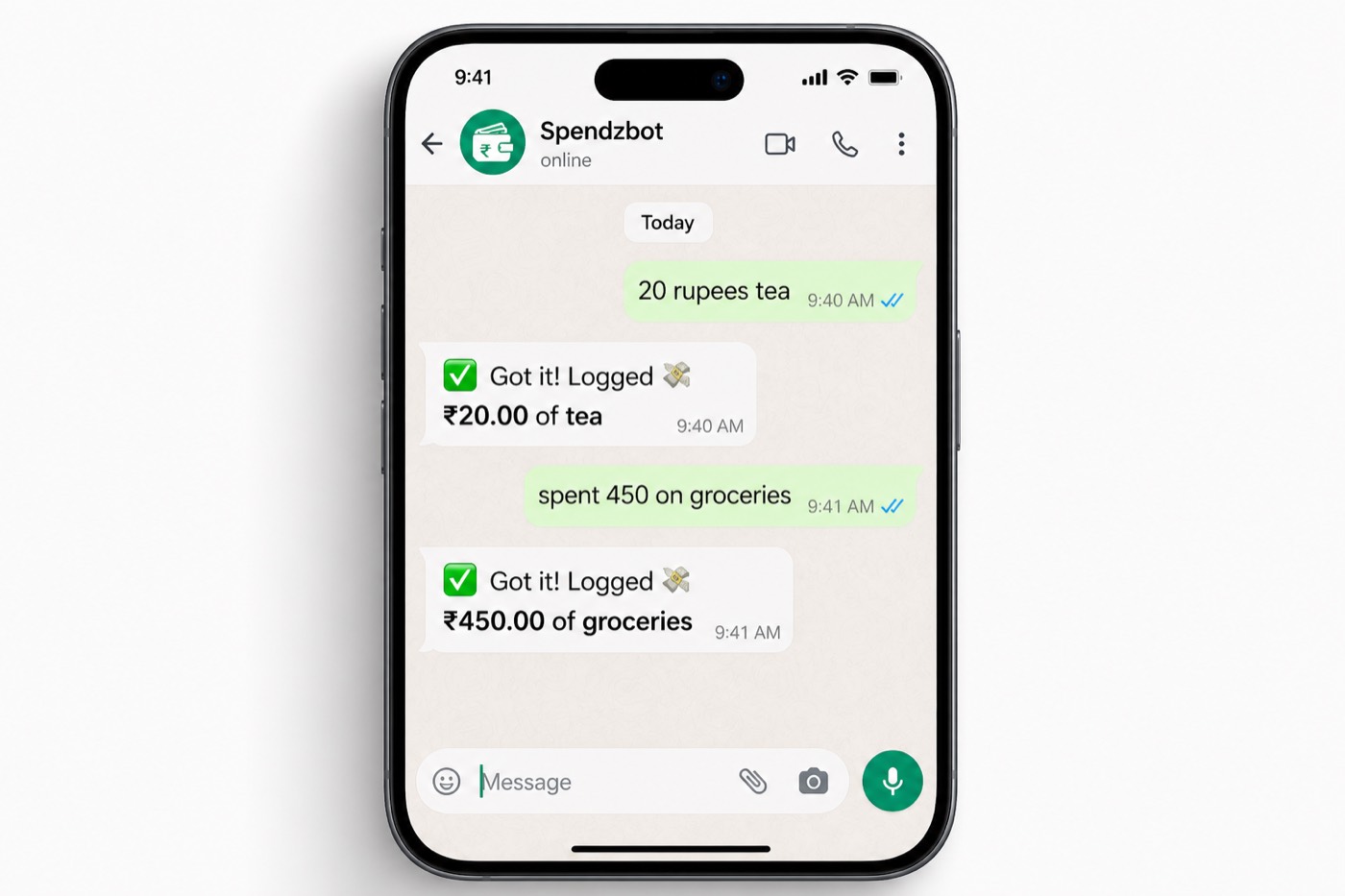
Then life continues. You log expenses on WhatsApp like always — tea 30, petrol 800, swiggy 350. Spendzbot by Asmora Labs handles the rest:
- Tracks month-to-date spend against your limits
- Sends budget alerts on WhatsApp at 75%, 90%, and 100% — before the month is already ruined
- Lets you check status anytime with
budgetorbudget status
The point is not the screen. The point is you decided early — so you are not discovering the damage on the 29th.
Why alerts matter more than regret
Regret is free. It also arrives too late.
I do not need a lecture after I overspend. I need a nudge while I still have choices. Spendzbot sends it straight on WhatsApp — right after you log a spend — when you cross 75%, 90%, or 100% of a limit:
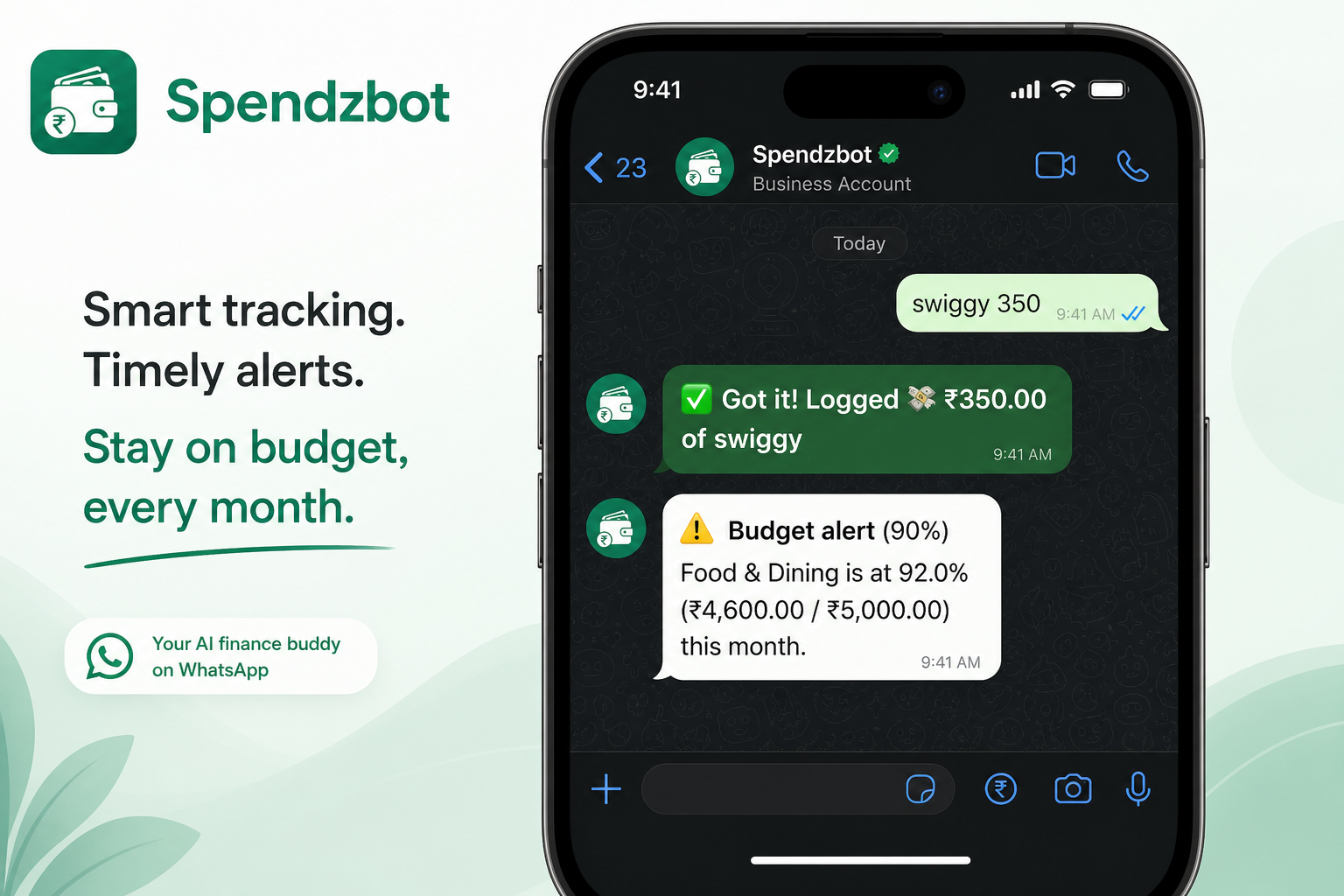
⚠️ Budget alert (90%) — Food & Dining is at 92.0% (₹4,600.00 / ₹5,000.00) this month.
That one line changes behaviour more than any motivational video. Not because I am scared — because I am informed. I can still order dinner. I am just doing it knowing the score.
That is why budget tracking matters in practice: it moves the conversation from “where did my salary go?” to “I know where it is going — and I am okay with it.”
Budget tracking for couples: peace is also a financial goal
If you share expenses with a partner, tracking is not optional — it is relationship hygiene.
Two people. One household pot. Fifty UPI apps. Different spending styles. Without a shared view, every month ends in mild suspicion even when nobody did anything wrong.
One household budget tracker, one truth. Individual attribution so you know who spent what — without turning every rupee into a courtroom drama.
Budget tracking will not fix every argument. But it removes the “I think you spent more” layer. And that alone is worth it.
You do not need to be a finance person — you need to stop flying blind
I used to think budget tracking was for people with calculators and Excel sheets.
Now I think it is for anyone tired of:
- Checking the balance and feeling confused
- Promising “next month I will manage”
- Earning okay money and still feeling broke
- Fighting about spends nobody can prove
You do not need perfection. You need visibility.
Log spends where you already live — WhatsApp. Set limits once on the web when you are calm, not panicked on the 25th. Let alerts do the reminding so willpower does not have to.
Text Hi to Spendzbot on WhatsApp, log your first expense, and set your monthly limits in Account Settings. Give it one month. Not to become a different person — just to finally know where the money went.
The salary is not the problem. The invisible spends are. Budget tracking makes them visible — and that is the whole fix.
FAQ: why budget tracking matters
Why is budget tracking important if I already check my bank balance?
Your bank balance shows what is left — not where it went, which category is leaking, or whether you are on pace to survive the month. Budget tracking connects daily spends to a plan so you can adjust mid-month, not after the damage.
Does budget tracking mean I cannot enjoy spending?
No. It means you choose your limits on purpose — then spend freely inside them. Tracking removes guilt and surprise; it does not remove joy.
Why do UPI users need budget tracking more than cash users?
UPI makes small spends feel invisible. Budget tracking makes those ₹30 and ₹50 taps add up to real numbers before month-end shock hits.
How does Spendzbot help with budget tracking in India?
Log expenses on WhatsApp in plain text, set overall and category budgets on the web dashboard, and get budget alerts at 75%, 90%, and 100% on WhatsApp. Message budget anytime for a status check.
Can couples share one household budget?
Yes. Spendzbot links up to two WhatsApp numbers to one shared account — one ledger, individual attribution, one set of monthly limits for the household.
Is budget tracking with Spendzbot free?
Yes. WhatsApp logging, budget limits, alerts, and reports are free while the product grows. Built by Asmora Labs for Indian WhatsApp numbers (+91).
More from the blog
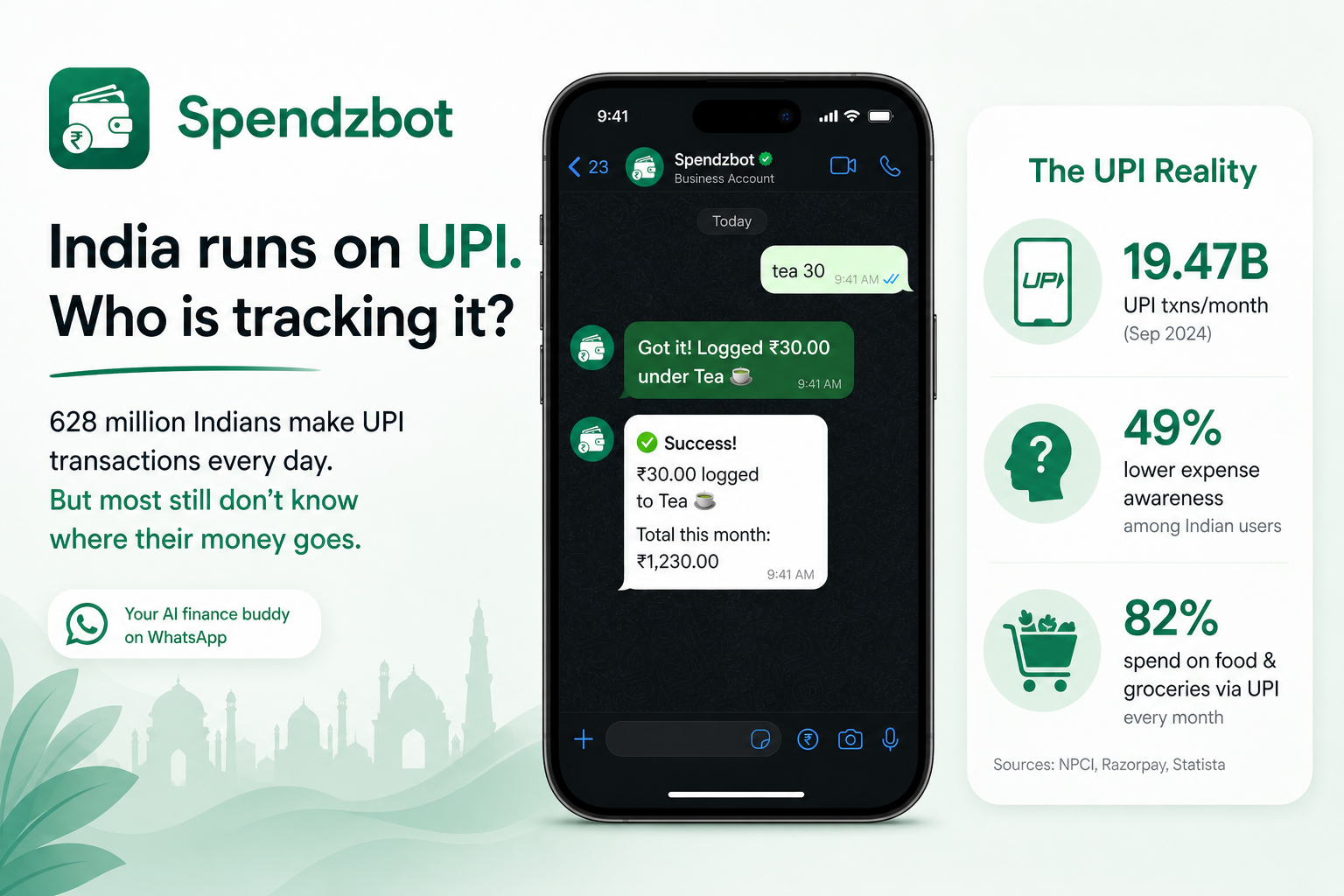
The Expense Tracking Habit in India: UPI Made Spending Easy — Tracking Didn't Follow
628 million UPI payments daily, but nearly half of Indians track less after going cashless. Data on expense trackers in India — and how to build the habit on WhatsApp with Spendzbot.
The Ultimate Guide to Ending the Everyday Expense Leak with Spendzbot
Stop the salary-to-empty-account cycle. Learn how Spendzbot uses WhatsApp and AI to track UPI spends, send budget alerts, and help couples manage money with zero friction.
WhatsApp Expense Tracker: Stop Silent Money Leaks with Spendzbot
Track daily expenses on WhatsApp with Spendzbot — an AI expense tracker. Log spends in one text, get monthly reports, and share a couple expense tracker. No app download.